
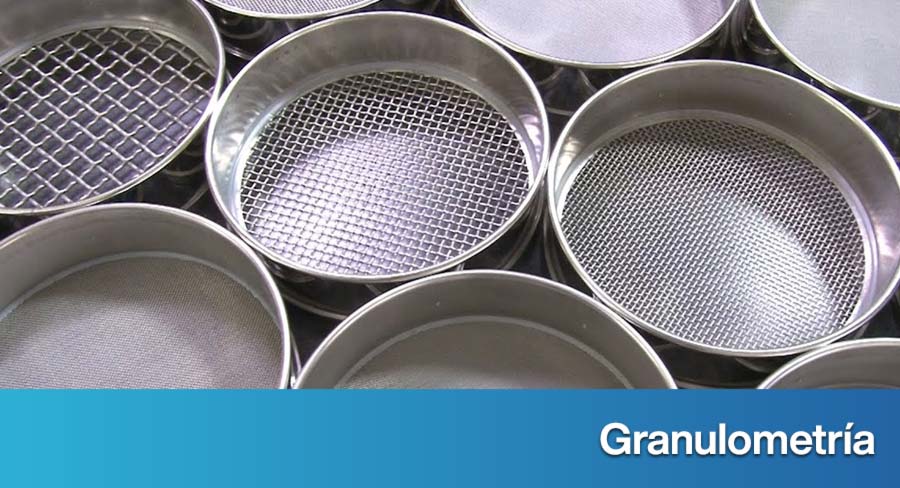
What is the particle size or mesh number of a granular medium?
Each sieve has a number that indicates how many crossing wires there are in one linear inch. A number 8 sieve has 8 vertical wires and 8 horizontal wires per inch. This creates an 8 × 8 grid of openings within each square inch. For example, a number 8 sieve has eight openings per inch in each direction.
Screening separates a mix of particles into fractions of different sizes. Larger particles are retained on a sieve, while smaller particles pass through and continue until another sieve holds them.
Sieves are used in stacks to obtain several fractions and determine the particle size distribution. They are suitable for particles larger than about 50 microns (0.050 mm).
Each mesh has a number that indicates how many cross threads there are in one linear inch. A mesh number 8 has 8 vertical threads and 8 horizontal threads per inch. This forms a grid of 8 × 8 spaces within each square inch. For example, a number 8 mesh has eight spaces per inch in each direction.
In water-treatment media, particle size is expressed with two numbers. For example, an 8 × 30 activated carbon contains particles that pass through the number 8 sieve and are retained on the number 30 sieve. This range corresponds to particles between 2.38 mm and 0.595 mm.
Example of laboratory sieves from the U.S.A. Standard Test Sieve series (ASTM E11 Specification)
Example of 8 and 30 sieves (8×30) |
|
 |
 |
Mesh 8 |
Mesh 30 |
Example of 12 and 40 sieves (12×40) |
|
 |
 |
Mesh 12 |
Mesh 40 |
U.S. Standard Sieve Number Conversion Chart to millimeters and inches
TABLE:
Mesh Number
(U.S. STD. Sieve) |
Opening (mm)
|
Opening (in)
|
4
|
4.76 |
0.187
|
5
|
4.00
|
0.157
|
6
|
3.35 |
0.132
|
8
|
2.38 |
0.0937
|
10
|
2.00 |
0.0787
|
12
|
1.68 |
0.0661
|
14
|
1.41 |
0.0555
|
16
|
1.19 |
0.0469
|
18
|
1.00 |
0.0394
|
20
|
0.841 |
0.0331
|
25
|
0.707 |
0.0278
|
30
|
0.595 |
0.0234
|
35
|
0.500 |
0.0197
|
40
|
0.420 |
0.0165
|
45
|
0.354 |
0.0139
|
50
|
0.297 |
0.0117
|
60
|
0.250 |
0.0098
|
70
|
0.210 |
0.0083
|
80
|
0.177 |
0.0070
|
100
|
0.149 |
0.0059
|
200
|
0.074 |
0.0029
|
325
|
0.044 |
0.0017
|
400
|
0.037 |
0.0014 |
What is effective particle size?
Filter media size is commonly specified in terms of effective size and uniformity coefficient, or in terms of particle size range. Effective particle size is defined as the mesh opening through which only 10% (by weight) of a representative sample of the filter media passes.
What is the uniformity coefficient?
It is the ratio calculated by dividing the mesh opening through which 60% (by weight) of a representative sample of a filter material passes by the mesh opening through which only 10% (by weight) of the sample passes.
What is the mesh size or particle size of the filter media or granular media?
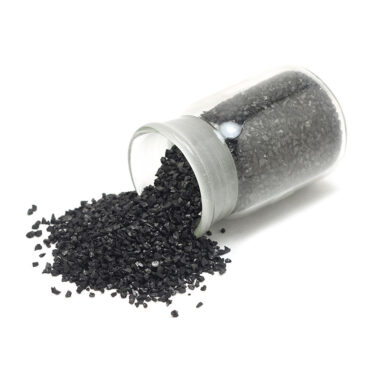
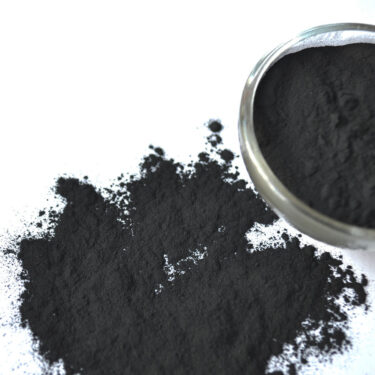
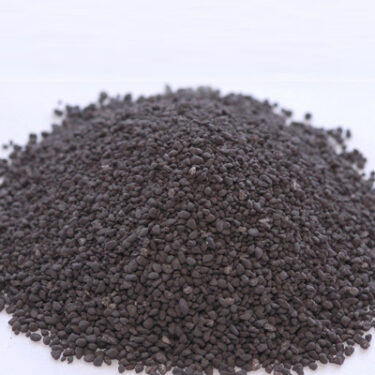
Activated carbon for water treatment: 325, 200, 8×30, 12×40 and 20×50 mesh.
Activated carbon for air and gas treatment: 4×10 and 14×30
Silica sands: 10×20 and 20×30
Anthracites: #1 14×30, #1.5 10×20, #2 4×12
Zeolite: 14×40
History and development of the U.S. Standard Sieve for mesh size or particle size classification.
The US Standard Sieve Series, commonly known as the US Standard Sieve Series, was developed in the early 20th century by the ASTM (American Society for Testing and Materials). The need for a standardized grading system arose with the rise of industrialization, where consistency and accuracy in particle size became crucial for various industrial applications, including filtration.
Structure and principle of operation
The US Standard Sieve system classifies particles based on their size using a series of mesh sieves, each with a specific number of openings per linear inch. Each sieve has a numerical designation corresponding to these openings, allowing precise categorization of particles. For example, a number 4 sieve has 4 openings per linear inch, while a number 200 sieve has 200 openings per linear inch.
Importance in the classification of filter media
In the filtration industry, particle size is crucial in determining the efficiency and capacity of a filter media. Granular filter media, such as sand or activated carbon, must have a specific particle size to ensure effective filtration and prevent the passage of unwanted contaminants. The use of the US Standard Sieve allows for accurate grading, ensuring that the filter media meets the required quality standards.
Management and regulations
Maintenance and calibration of the sieves is essential to ensure accurate and consistent results. ASTM provides detailed guidelines on the care and calibration of sieves, including methods for checking the size of apertures and recommendations for cleaning and storage of sieves.
Industrial applications
In addition to filtration, the US Standard Sieve system is used in a wide range of industries, including pharmaceutical, food, mining and construction. In each of these industries, accuracy in particle classification is crucial to the quality of the final product and the efficiency of the production process.
The US Standard Sieve particle size is a mainstay in the classification of granular and powdered filter media. Its development by ASTM and its implementation in various industries has allowed standardization that guarantees quality and efficiency in numerous processes. The understanding and proper use of this system is essential for any professional working with granular or powdered materials, ensuring accurate and reliable results.
Related articles:
Share:
If you need more information, please contact us.
Some products that may interest you
-
Zeolite Turbidex – Water Filtration Media
Add to quote -
Micro 10 Activated carbon from coconut shells
Add to quote -
Katalox Light – Iron and Manganese Removal
Add to quote -
Megapol E – Wood powdered activated charcoal
Add to quote -
Gama L – Lignite coal mineral activated carbon
Add to quote -
Gama B – Bituminous Coal Activated Carbon (Mineral)
Add to quote -
Micro 4 Activated carbon for water purification
Add to quote -
Filox – R for iron and manganese removal
Add to quote













I enjoy your writing style truly loving this web site .
Whoah this blog is excellent i really like reading your posts. Keep up the great paintings! You already know, many persons are hunting round for this info, you can aid them greatly.
It’s great page, I was looking for something like this
very nice post, i definitely adore this website, continue it
Thank you for all your valuable hard work on this website. Betty takes pleasure in engaging in research and it’s really obvious why. I learn all relating to the lively way you render rewarding items on this blog and even improve contribution from the others on this concept so my princess is without a doubt starting to learn a lot of things. Take pleasure in the rest of the year. You have been doing a dazzling job.
I’m impressed, I have to admit. Really rarely do you encounter a weblog that’s both educative and entertaining, and without a doubt, you might have hit the nail around the head. Your notion is outstanding; the thing is a thing that insufficient consumers are speaking intelligently about. We’re happy we came across this within my hunt for some thing relating to this.
I always was concerned in this subject and still am, regards for putting up.
Thanks for this post, I am a big fan of this web site would like to proceed updated.
It’s rare knowledgeable people during this topic, however, you seem like do you know what you’re discussing! Thanks
I see something genuinely special in this site.
Keep up the good work , I read few posts on this web site and I conceive that your blog is very interesting and has sets of fantastic information.
Your article is truly informative. More than that, it’s engaging, compelling and well-written. I would desire to see even more of these types of great writing.
Aw, this has been quite a nice post. In thought I have to devote writing this way additionally – spending time and actual effort to have a really good article… but what can I say… I procrastinate alot and by no means apparently get something carried out.