Description
What is Turbidex zeolite?
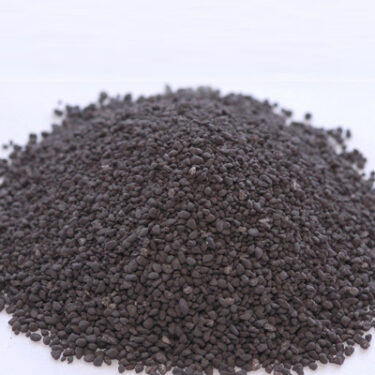
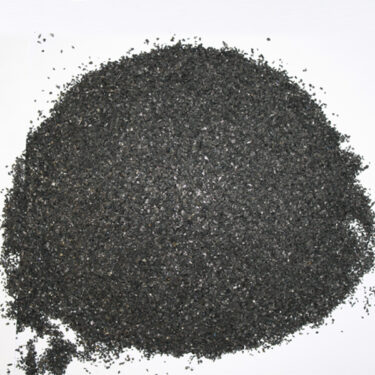
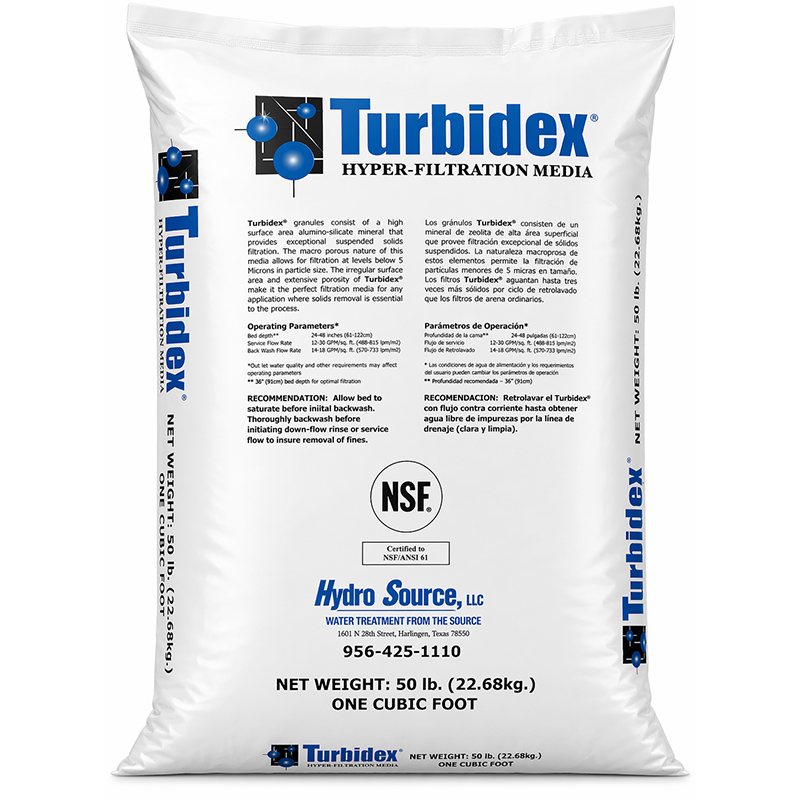
Turbidex™ is a state-of-the-art water filter media manufactured from clinoptilolite, a natural zeolite of volcanic origin composed of high purity aluminosilicates with low sodium content. It is extracted, crushed, dried and double-screened to obtain granules with a uniformity coefficient of 1.64, ensuring a homogeneous filter bed with low pressure drop.
Unlike silica sand or anthracite, which retain particles only by mechanical sifting, Turbidex also incorporates mild ion exchange, electrostatic adsorption and assisted flocculation. Its granules have surface micro-projections with separations of 0.25 to 10 mm that efficiently trap suspended solids. The result is filtered water with turbidity consistently below 0.1 NTU, a level of clarity that conventional multimedia filters are unlikely to achieve.
Why does Turbidex outperform multimedia filters?
Superior filtration compared to conventional media
Conventional silica sand filters retain particles of approximately 25 microns. A multimedia filter (deep bed with sand, anthracite and garnet) improves this figure to a range of 10 to 12 microns. Turbidex™, thanks to the combination of mechanical sieving, ion exchange and electrostatic adsorption, has the potential to significantly improve the retention micronage over these conventional media. The manufacturer reports filtration efficiencies in the range of 3 to 5 microns under controlled conditions, although actual performance will depend on factors such as feed water quality, service velocity, bed depth and the nature of the suspended solids present.
In practice, this translates into a consistently clearer effluent than that from a multimedia filter, with turbidity that can reach values below 0.1 NTU depending on operating conditions. This improvement in filtrate quality protects downstream equipment such as reverse osmosis membranes, polishing cartridges and UV lamps, helping to extend their useful life and reduce maintenance costs.
Increased solids retention capacity
Thanks to its high surface area (14 to 25 m²/g) and its macroporous structure, the manufacturer reports that Turbidex™ has a loading capacity up to 1.5 times higher than a conventional media bed and up to 2.8 times higher than a silica sand filter. However, it is important to note that these values are obtained under specific test conditions. In practice, the difference in retention capacity between Turbidex™ and a well-designed multimedia may be less pronounced depending on feed water quality, solids particle size and system operating conditions.
What is consistent in the field is that Turbidex™ tends to offer longer operating cycles between backwashes, which translates into less backwash water consumption and less filter downtime. The magnitude of this advantage will vary with each application, so we recommend evaluating the specific conditions of your project with our technical team.
High service flow rates
Turbidex™ operates at nominal flows up to 15 gpm/ft² in pressurized tanks, with the ability to handle peaks up to 20 gpm/ft². In gravity filtration systems, it supports flows of 4 gpm/ft². These rates allow smaller diameter tanks to be used for the same flow rate, reducing initial equipment investment.
One medium replaces three
With Turbidex™, the need to load the filter with layers of silica sand, anthracite and garnet is eliminated. A single filter media performs the function of all three, simplifying project specification, in-plant storage, tank loading and replenishment logistics. Installation is completed in a fraction of the time required for conventional multimedia.
Lightweight: freight and handling savings
With a bulk density of just 50 lbs/ft³ (~0.80 kg/L), Turbidex™ weighs 50% to 70% less than traditional filter media. This represents significant savings in transportation costs, especially in long-distance shipments or to hard-to-reach locations, and facilitates material handling during filter loading.
Turbidex™ technical specifications
Parameter |
Value |
|---|---|
Composition |
High purity, low sodium, natural aluminosilicate (clinoptilolite) |
Mesh |
14 × 30 U.S. Std. Mesh |
Color |
Cream white (off-white) |
Bulk density |
50 lbs/ft³ (~0.80 kg/L) |
Surface area |
14 to 25 m²/g |
Uniformity coefficient |
1.64 |
Thermal stability |
Up to 500 °C |
Regulatory Classification |
GRAS (21 CFR 182.2729 and 40 CFR 180.1001) |
Certification |
ANSI/NSF Standard 61 |
Presentation |
1 ft³ bag (22.7 kg / 50 lb) |
Recommended operating parameters
Parameter |
Range |
|---|---|
Bed depth |
76 to 122 cm (30 to 48 inches) |
Freeboard space |
50% of bed depth |
Service flow |
12 to 20 gpm/ft². |
Backwash flow rate |
14 to 18 gpm/ft². |
Replacement ratio vs. multimedia |
1:1 (volume for volume) |
Estimated useful life |
4 to 6 years with periodic backwashing |
Comparison: Turbidex vs. silica sand vs. multimedia
Characteristics |
Silica sand |
Multimedia (sand + anthracite + garnet) |
Turbidex™ |
|---|---|---|---|
Nominal filtration |
~25 µm |
10-12 µm |
Higher than multimedia (fab. reports 3-5 µm)* |
Effluent Turbidity |
1-5 NTU |
0.5-1 NTU |
< 0.1 NTU (depending on conditions) |
Load capacity (reference) |
1× |
~1.5× |
Up to 2.8× (fab.*, varies in field) |
Service flow (pressure) |
4-6 gpm/ft² |
6-8 gpm/ft² (peak 20) |
12-15 gpm/ft² (peak 20) |
Number of media |
1 |
3 |
1 |
Bulk density |
~100 lbs/ft³ |
85-100 lbs/ft³ |
50 lbs/ft³ |
Cert. NSF 61 |
Variable |
Variable |
Yes |
*Data reported by manufacturer under controlled conditions. Actual performance will vary with water quality and operating conditions.
Industrial and commercial applications
Turbidex is the technical choice for any process where suspended solids removal is an operational requirement:
- Pretreatment for reverse osmosis and ultrafiltration: Protects membranes from premature fouling, reduces the frequency of chemical cleaning (CIP) and extends the life of membrane elements.
- Municipal and industrial drinking water: Meets the turbidity criteria required by NOM-127-SSA1 (< 5 NTU) with a wide margin, with the potential to produce water with turbidity below 0.1 NTU depending on operating conditions.
- Food and beverage industry: Clarification of process water and water for processing, compatible with processes certified under NSF standards.
- Tertiary wastewater treatment: Final polishing for reuse of treated water in irrigation, ancillary services or discharge to receiving body.
- Cooling towers and recirculation circuits: Removal of suspended solids that cause incrustation, corrosion and microbiological proliferation.
- Pharmaceutical and electronics industry: Prefiltration in purified water and ultrapure water trains.
- Mining and petrochemical industry: Filtration of process water with high sediment load.
- Purification and filling plants: Pre-filtration before UV lamps and carafe filling.
How much Turbidex zeolite do I need?
The amount of media depends on the diameter of the tank and the required bed depth. As a general guideline, 30 to 48 inches of bed depth with 50% freeboard is required for expansion during backwashing. Our technical team can size your system based on your design flow rate, feed water quality and effluent requirements. Request a custom quote.
Turbidex™ at Carbotecnia: technical advice included
Carbotecnia markets Turbidex™ zeolite for industrial, commercial and municipal projects in Mexico and Latin America. In addition to the supply of the filter media, we offer technical advice for the sizing of deep bed filters, selection of control equipment (automatic or manual valves) and commissioning. If you require a technical comparison between Turbidex™ and other filter media such as NextSand™ for your specific application, please contact us.
Regulations
- https://www.nsf.org/knowledge-library/nsf-ansi-standard-61-drinking-water-system-components-health-effects – Official NSF page on Standard 61. Link from where the NSF 61 certification is mentioned.
- https://www.dof.gob.mx/nota_detalle.php?codigo=5650705&fecha=02/05/2022 – Official text of NOM-127-SSA1-2021 in the Official Journal of the Federation. Link from the mention of the Mexican drinking water standard. High DA (~70+), government source.