Description
What is Silica Sand?
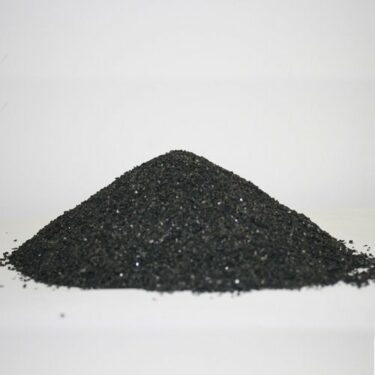
Silica sand is a compound resulting from the combination of silica with oxygen. Its chemical composition is made up of one atom of silica and two atoms of oxygen, forming an very stable molecule: SiO₂.
This molecule is insoluble in water and is found in nature in the form of quartz. If the quartz is crystallized it is called Rock Crystal.
It belongs to the silicate class and to the trigonal crystalline system. This mineral is very rich in varieties, which can be grouped into Macrocrystalline, with crystals well visible to the naked eye, and Cryptocrystalline, formed by microscopic crystals.
Silica sand is characterized by its high purity, which makes it ideal for use in industry and construction. It also stands out for its hardness and resistance to wear caused by friction.
Another of its characteristics is its chemical stability. Even in the presence of high temperatures, this type of sand does not react easily with other compounds.
Chemical composition of silica sand.
Silica sand is mainly composed of quartz, more specifically or mostly white quartz (silicon dioxide), this mineral is considered the most abundant on earth. In addition to quartz it contains 5% of other minerals.
Impurities are usually mineral in nature and, like quartz, resist transport and weathering processes.
Chemical analysis |
Composition |
YesO₂ |
98.5% |
Fe₂O₃ |
0.054% |
Al₂O₃ |
0.406% |
Na₂O |
0.010% |
TiO₂ |
0.071% |
K₂O |
0.110% |
CaO |
0.010% |
Typical values. These do not represent a specification.
Uses and applications of silica sand
The industrial uses of silica sand derive from its physical and chemical properties. Among its main characteristics are: its hardness, chemical resistance, high melting point, piezoelectricity, pyroelectricity and transparency.
The sands are mainly used:
- As a filter bed for water purification and potabilization (for the retention of very small floccules that are not separated by decantation).
- Due to their hardness, they are used for the manufacture of lyes, industrial abrasives and sandblasting.
- It is a very important raw material in the composition of detergent formulas, paints, concretes and special mortars, and is the basic raw material for obtaining silicon, as well as the basis for the manufacture of silica refractories and model sands, due to its high melting point.
Silica sand for multimedia or deep bed water filters.
In the context of water treatment, it is most commonly used for deep bed or multimedia water filters.
Silica sand for water purification is especially suitable for applications in drinking water treatment systems, wastewater, swimming pools, aquariums and industrial processes. In addition, it is wear-resistant, non-toxic and non-flammable, making it safe and easy to handle.
Silica sand is a durable, low-maintenance filter media that can be used in gravity or pressure filtration systems. Being a natural product, it is not only environmentally friendly, but also highly effective in removing impurities, making it an economical and efficient alternative to other filter media.

Benefits of silica sand for water filtration.
Increased filtration efficiency
The combination of silica sand and anthracite in dual filters allows for better separation of suspended particles in the water, as sand has smaller grains and is heavier than anthracite. This ensures that the sand layer is deposited below the anthracite and provides finer filtration.
Improved flow distribution
The combination of silica sand and anthracite improves the distribution of water flow through the filter, resulting in more uniform and efficient filtration.
Less backwashing
Due to the higher solids holding capacity and better flow distribution, silica sand and anthracite media filters may require less backwashing than single sand filters, reducing water and energy consumption.
Higher solids holding capacity
Multimedia filters with silica, garnet and anthracite sand have a higher solids holding capacity compared to single sand filters, allowing the filter to run longer before requiring backwashing.

Configuration of dual deep bed filters and multimedia filters.
Dual silica sand and anthracite filters.
Dual filters are composed of two granular media. The first, anthracite, is a high porosity mineral carbon that retains larger particles and has a lower density than silica sand.
Silica sand is placed on top of the supporting gravel bed as it has a higher density than anthracite as well as a smaller particle size which helps to capture finer contaminants and evenly distribute the water flow to the bottom of the tank.

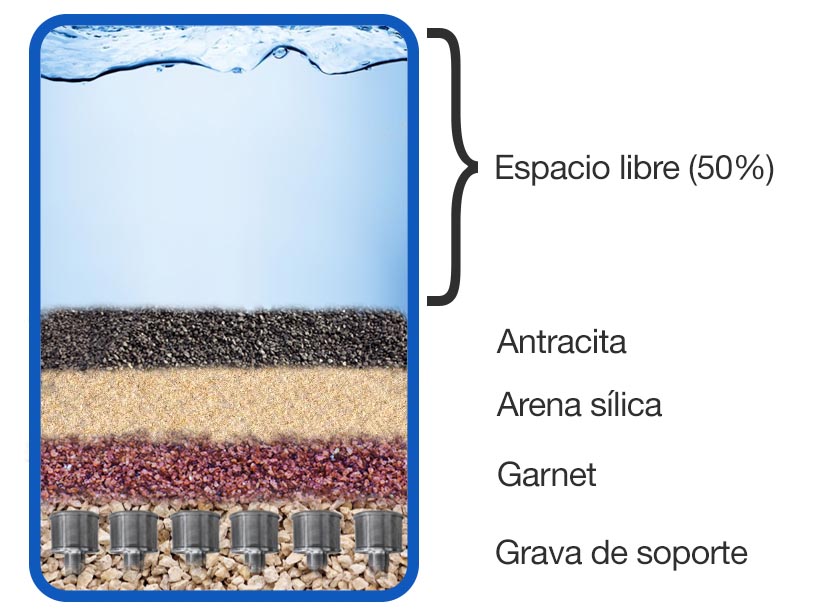
Anthracite, silica sand and garnet multimedia filters
Multimedia filters combine the capabilities of filter media by integrating a high-density garnet layer that optimizes filter design and remains below the silica sand in backwashing.
As in the multimedia filter, the anthracite is above the silica sand, but in this case it is the garnet that retains the finer contaminants after the fluid passes through the sand.
At the bottom, in both cases, there is a layer of gravel support where the nozzles for the collection of treated water and the backwashing of the tank are also located.
Product technical specifications
Specification |
Value |
Standard |
|---|---|---|
Sand color |
White to light brown |
– |
Color (generated in water by organic impurities) |
Value lower than standard color |
ANSI /AWAA B100 and ASTM C40 |
Shape |
Subangular to rounded |
– |
Average bulk density without compaction |
1.43 g/cm³ |
– |
Average compacted bulk density |
1.62 g/cm³ |
– |
Purity |
Free of organic matter and clay. |
ANSI /AWAA B100 |
Specific Gravity |
2.5 – 2.65 |
ANSI /AWAA B100 and ASTM C128 |
Particle size range (EU standard mesh) |
16 x 35 |
ANSI /AWAA B100 and ASTM C136 |
Effective particle size (mm) |
0.44 – 0.52 |
ANSI /AWAA B100 and ASTM C136 |
Uniformity coefficient (max.) |
1.7 |
ANSI /AWAA B100 and ASTM C136 |
Material smaller than 200 mesh EU standard (% max) |
2.0 |
ANSI /AWAA B100 |
Solubility in acid (%) |
0.5 |
ANSI /AWAA B100 |
Our silica sand is evaluated according to ANSI / AWWA B100 standard criteria for use in water filtration processes.