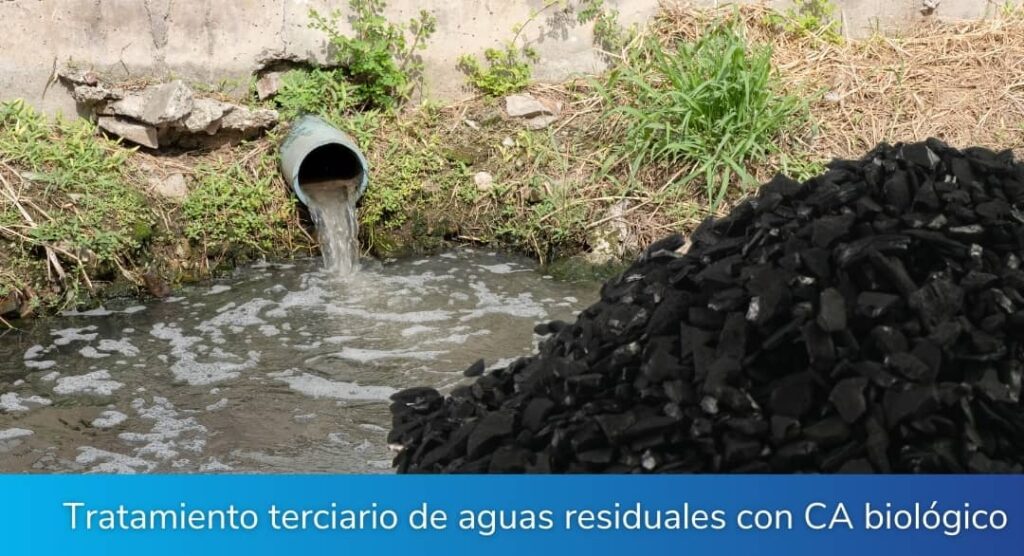
Tertiary Wastewater Treatment
In tertiary wastewater treatment, the water has gone through a first stage of sedimentation and/or flotation that has removed a large part of the suspended solids as well as part of the organic matter by mechanical means. The water also undergoes biological treatment to remove dissolved organic matter and pathogenic microorganisms in the secondary treatment stage.
Tertiary wastewater treatment is a final stage that seeks to “polish” the fluid to obtain a higher purity than that achieved by physicochemical and biological methods.
By means of tertiary wastewater treatment, specific pollutants can be removed to meet the desired characteristics of the user, such as odor and color.
When treated wastewater will be discharged into natural water bodies or reused for irrigation, for example, additional treatments are necessary to comply with the permissible limits of the wastewater quality standards.
In Mexico, the Official Mexican Standard NOM-001-SEMARNAT establishes the limits of permissible contaminants when wastewater is discharged into receiving bodies owned by the country.
Tertiary treatment of wastewater with activated carbon
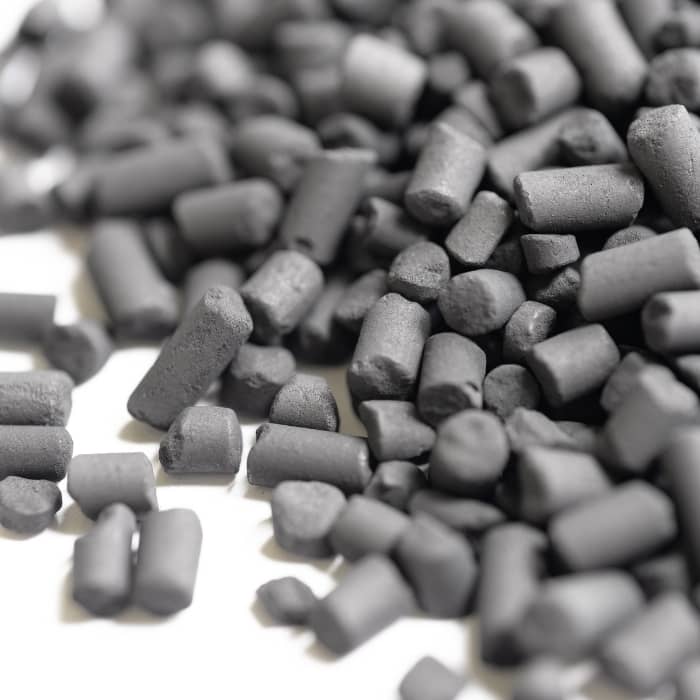
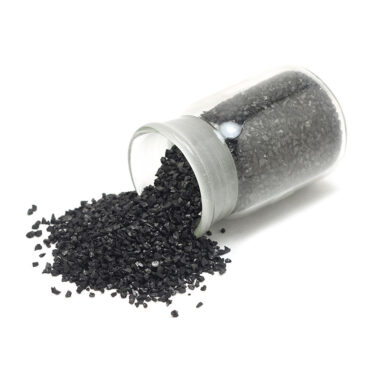
Activated carbon is a type of carbon that has had its porosity increased resulting in a larger surface area compared to non-activated carbon. It can be produced from coconut shell, wood or mineral origin. Its activation process can be thermal or chemical. Activated carbon for tertiary wastewater treatment can be applied in granular or powdered form.
Activated carbon is able to improve the color, odor and taste of water in general.
One indicator of wastewater quality is COD (Chemical Oxygen Demand), the result of which can give an estimate of the oxidizable organic pollutants still present in the water after primary and secondary treatment.
Carbon due to its chemical structure of covalent character usually seeks to satisfy the electromagnetic imbalance with other molecules of covalent character. This results in a low-intensity bond (London force) between the carbon and the approaching fluid molecules. This phenomenon is called adsorption.
The organic molecules that affect COD levels are covalent in nature, so the activated carbon will adsorb them, resulting in a lower COD level and improving the overall quality of the wastewater, making it suitable for discharge into natural water bodies.
Activated carbon is capable of retaining low polar, covalent and non-dissociated contaminants that are usually of organic origin in any concentration, however, it is applied in tertiary treatment since, in technical-economic terms, it is competitive with respect to other processes, to bring the levels of organic contaminants from “relatively low” to “very low”.
For example: if, after primary and secondary treatment, the water still contains a COD between 30 and 100 mg/l, it can be reduced to values between 2 and 10 with activated carbon.
Another example: if after the primary and secondary treatments, the water already meets the expected COD, but still has a color or odor of organic origin, activated carbon can remove it.
Now, talking about color, the use of activated carbon in tertiary wastewater treatment can be useful when the color is due to the presence of organic compoundsThe activated carbon does not efficiently adsorb inorganic compounds.
Turning to wastewater toxicity, activated carbon is widely used as an antidote by adsorbing toxic organic compounds.
If fats and oils are present, additional technologies and treatments will be required to eliminate free or emulsified oil, even if they are organic compounds, since they interfere with the adsorption capacity of the activated carbon by impregnating and blocking it.

Biological activated carbon in tertiary wastewater treatment
Biodegradable organic molecules that could not be degraded in the biological treatment will be adsorbed by the activated carbon specifically when applied in granular form. This accumulation of biodegradable organic molecules attracts bacteria that will settle on the surface of the activated carbon and feed on the organic molecules. This phenomenon is known as biological activated carbon . This type of carbon is also useful for the tertiary treatment of wastewater, since there is a concentration of organic pollutants in the wastewater.
The bacteria will generate carbon dioxide, methane, water as well as assist in the generation of more bacteria. The bacteria by consuming the adsorbed organic molecules allow the carbon to have free surface area to adsorb more organic pollutants which will again serve as food for the bacteria.
In addition, Carbotecnia can help you comply with NOM-001-SEMARNAT-2021, which establishes the maximum permissible limits of pollutants in wastewater discharges into receiving water bodies owned by the nation. The use of biological activated carbon in tertiary treatment is an effective solution to ensure that discharges meet the standards established by these regulations, ensuring environmental protection and compliance with current legislation.

Activated carbon to comply with NOM-001-SEMARNAT-2021 in Mexican territory.
As mentioned above, NOM-001-SEMARNAT establishes the permissible limits for wastewater to be reintroduced into the environment when discharged into receiving bodies owned by the nation.
NOM-001-SEMARMAT-2021 is an update of the standard that became applicable in Mexican territory on April 3, 2023.
Among its modifications we find:
- Limiting the COD (Chemical Oxygen Demand) value instead of limiting the BOD (Biochemical Oxygen Demand) value.
- Added a limit to the true color not present in the previous version.
- A water toxicity limit not present in the previous version was added.
When the value of these parameters is caused by organic compounds, biological activated carbon is a very competitive option for compliance in tertiary wastewater treatment.
Other activated carbon applications in wastewater treatment

Application of activated carbon in wastewater pretreatment
There are cases of wastewater treatment where granular activated carbon (GAC) is used in the pretreatment stage as shown in the diagram above.
This is done when the water contains one or more contaminants that would hinder or prevent biological treatment, also known as secondary treatment. These contaminants can be molecules that are toxic to bacteria, such as benzene, toluene, phenol, chlorinated and nitrated compounds, pesticides, tannins, lignin, among others. They can also be molecules called “refractory” because they are difficult to digest or degrade by microorganisms. The latter are usually of high molecular weight.
To be successful in this application, it is necessary to select activated carbon whose predominant pore diameter is slightly larger than the diameter of the molecule to be retained. And it is also necessary that there are not many other molecules of the same size and similar adsorbability (of similar polarity, covalent character and non-ionicity), so that there is not much competition for the active sites of the carbon. Otherwise, the carbon would be saturated with all kinds of organic compounds which, at this stage of treatment, are in high concentration.
The application of activated carbon in the pretreatment stage is usually done in fixed beds, such as GAC. However, it can be done, if convenient, as powdered activated carbon (PAC).
Application of activated carbon in secondary wastewater treatment
There are cases in which, instead of applying activated carbon in the pretreatment, it is added as PAC in the aerobic biological treatment tank, with the same purposes: to retain refractory molecules or molecules toxic to bacteria. In this way, the results of the biological treatment are greatly improved.
As mentioned in the previous paragraph, a PAC should be chosen whose predominant pores lead it to retain the desired molecule.
This process is called the “PACT process”. The carbon is separated from the water together with the activated sludge by sedimentation and filtration.
Difference between granular and powdered activated carbon
Granular activated carbon (GAC) and powdered activated carbon (PAC) are exactly the same. They are manufactured in the same process and, at the end of the process, the latter is pulverized and the former is not. Many people believe that PAC has more capacity, based on the belief that it has a larger surface area than GAC. But this is not so, since the large area of an activated carbon is at the molecular level and practically does not increase with its pulverization. What does increase in PAC is the kinetics with which it works. This is due to the decrease in the length of its pores, which are filled by a capillary phenomenon when the carbon is put into operation.
Based on the above, GAC and PAC perform the same physicochemical function: they adsorb low polar, covalent and non-dissociated compounds, i.e. mainly organic. The only difference between the two carbons is of a mechanical nature: it lies in their size and, therefore, in the way they are applied.
A PAC is added to the water and mixed with it in an in-line static mixer (in the pipeline) or in an agitated tank. It is then separated from the water by coagulation-flocculation-sedimentation and/or filtration (filter press).
A GAC is installed in a fixed bed inside a tank. The water to be treated is percolated through the GAC bed.
The advantage of PAC is that it can be dosed according to the quality of each batch to be treated (although it can also be applied in a continuous process). Its disadvantage is that it must be separated from the water (as mentioned: by coagulation-flocculation-sedimentation and/or filtration).
If you need tertiary wastewater compliance, contact us to help you.
More information on the update of NOM-001-SEMARNAT and its permissible limits can be found in this article: Activated carbon for compliance with the new limits allowed by NOM-001-SEMARNAT-2021
(True color and acute toxicity limits will be applicable on March 12, 2026.)
More information:
Activated carbon filters for drinking water – Filtrashop
NOM-001-SEMARNAT-2021, which establishes pollutant limits for wastewater discharges, is published.
Share:
If you need more information, please contact us.
Some products that may interest you
-
Amin-Carb Activated carbon for amine treatment
Add to quote -
EBA-9 Activated carbon for treatment of tequilas and other distillates
Add to quote -
Carvapur pellet – Activated carbon for organic gases
Add to quote -
Gama L – Lignite coal mineral activated carbon
Add to quote -
Gama B – Bituminous Coal Activated Carbon (Mineral)
Add to quote