Activated carbon for aquariums
In this article we are going to talk about the function that activated carbon or aquarium activated carbon can have. For some time activated carbon has been used to remove colorations that may arise in aquarium water or to remove debris that may be present in the water. These two functions are the most common, but there are other applications such as removing ozone molecules or some free oxygen atoms.
Functions of activated carbon
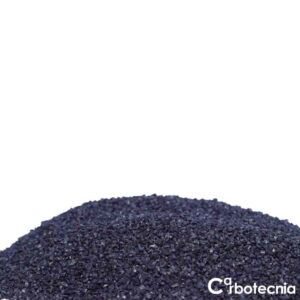
Activated carbons have the capacity to adsorb organic compounds and can be applied in gases, vapors or liquids in order to function as a filter.
Activated carbon is recognized for having a similar appearance in each particle that composes it. Its adsorption capacity is proportional to the number of micropores it has.
Factors affecting the adsorption capacity of activated carbon
The first is the molecular structure, the characteristics of the element to be adsorbed directly influence the efficiency of the activated carbon. Larger molecules are easier to filter and smaller molecules the opposite. It is worth mentioning that those with lower solubility and low polarity are absorbed earlier.
Inorganic compounds can be adsorbed more easily. Salts associated with potassium chloride and sodium sulfate cannot be adsorbed.
The solubility of the compounds has an influence as more soluble compounds are more difficult to adsorb than less soluble ones.
Another factor is ionization, which is contrary to adsorption, therefore, ionized substances are difficult to adsorb except for hydrogen ions on certain occasions.
Finally, temperature can also be a factor affecting adsorption capacity as it can be decreased at high temperatures.
How can activated carbon be used in an aquarium?
Its use in aquariums is as a filtering system to retain vitamins, proteins, fats, heavy metals, natural toxins of living beings, among many others.
Just as its function can be very beneficial inside the aquarium, it can also have a negative effect and adsorb beneficial and indispensable elements in the life of aquatic beings.
If we take into account the above points, it is logical to think that the use of activated carbon should be regulated by an expert to keep it under control and in optimal conditions.
The use of activated charcoal may imply a heavy expense for an amateur as he/she will need more additives and supplements. Another effect that can be negative is that it can prevent us from detecting problems because we do not detect odors.
It is recommended by aquarium experts that aquarium activated carbon be used in the last stage of filtration. At this stage the water usually arrives without particles that affect the adsorption capacity of the aquarium activated carbon.
Can activated carbon be used in aquarium cycling?
It can be used, but it is not recommended, since when the aquarium is being cycled a large amount of ammonia, ammonium, nitrites and nitrates are produced, which are in charge of generating nitrifying bacteria. If we use activated carbon in the cycling what we will do is to slow down this process. Therefore, it is recommended that the aquarium activated carbon be placed inside the filter until the cycling process is finished.
Can activated carbon be used in a planted aquarium?
It is not recommended to use activated carbon in this type of aquarium because it eliminates all types of liquid fertilizers from the aquarium, it eliminates all types of substances from harmful to beneficial. This causes that the use of chemicals to feed the algae that the aquarium may contain is useless.
The best way to use activated carbon for our aquarium is when we want to eliminate medication residues, algae explosions or nitrite or nitrate peaks in the aquarium water. Experts indicate that the estimated time to use activated carbon in the aquarium is 24 hours after the use of medications to treat the aquarium. In other cases, such as algae explosions or nitrite and nitrate peaks, activated carbon can be used until they disappear.
Can aquarium activated carbon be used in freshwater or saltwater aquariums?
Activated carbon can be used with both fresh and salt water, there is no problem. What we must take into account is that it should not be used without auxiliary filters that have a mechanical pre-filter.
In freshwater aquariums, aquarium activated carbon is always used as the last filter layer of the pressurized filter or in the last available cell of the backpack filter.
In saltwater or marine aquariums the aquarium activated carbon is placed in the filter collector or sump, it is also used in the last stage of the filter next to the return pump.
 Conclusion:
The aquarium activated carbon can be used in any type of aquarium, but it is important to consider that its prolonged use will depend on the fish contained in our habitat (fish, plants or corals). It will also depend on the treatments we are administering for the fish or fertilizers for the plants.
It should be taken into account that if the water in our aquarium is not completely clear and has an unusual odor or color, activated carbon is the best solution.
Related articles
If you need more information or a quote, please contact us: