Desalination solves water. It also creates a challenge: brine. This concentrate is discharged into the sea in many plants. Its management defines much of the environmental impact and operating cost.
What is brine mining?
Brine mining is the process by which valuable minerals are extracted from highly concentrated salt solutions, such as those generated in salt flats or desalination plants. Traditionally, this technique has been used in areas such as the Lithium Triangle (Argentina, Bolivia, Chile), where brine is evaporated to obtain lithium, potassium, boron and other minerals.
Brine mining recovers salts and metals from high salinity solutions. It operates in salt flats and also in industrial streams. It includes brine from desalination plants and other concentrated streams.
What changes with desalination plants?
A reverse osmosis plant produces water and a saline reject. This reject usually has a higher salinity than seawater. Sometimes it doubles the concentration. That difference matters because:
-
Increases salt recovery potential
-
Reduces the volume per unit of ore recovered
-
Complicates fouling and corrosion if not designed properly
From “discharge” to “process current”.
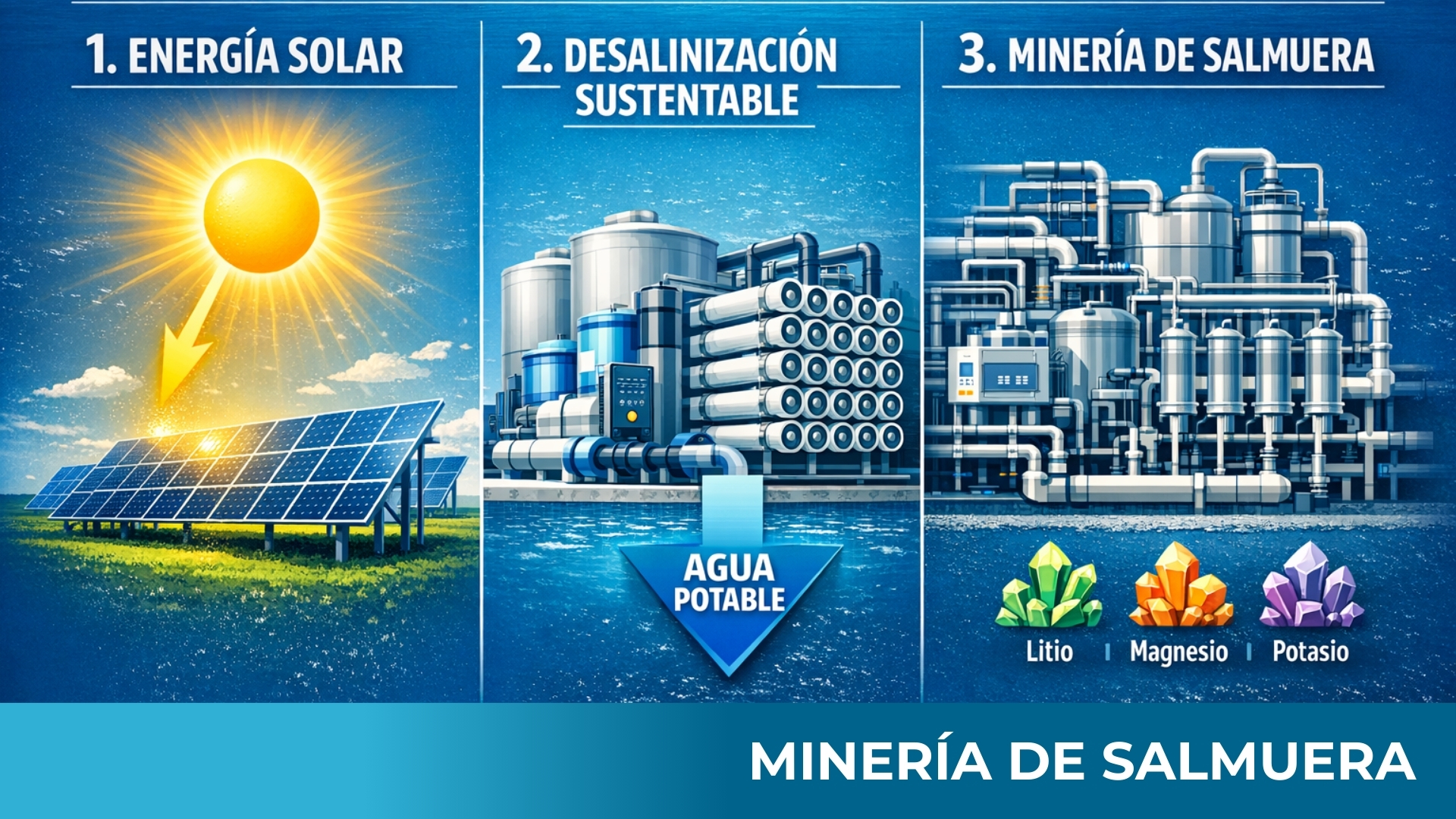
The new approach treats brine as a raw material. Instead of sending it directly to the sea, a line is designed to recover value and reduce the discharge impact.
Which minerals are of interest
Targets depend on the site and the chemistry of the reject. The most commonly mentioned:
-
Magnesium
-
Calcium
-
Potassium
-
Lithium, to a lesser extent because of its low concentration in seawater
Lithium from seawater
Lithium has become essential for electric car batteries and energy storage. Although it was traditionally extracted from mines or salt flats, it is now possible to obtain lithium directly from seawater, using selective separation technologies, advanced membranes and electrosorption.
Instead of returning the waste to the sea, new technologies are extracting valuable minerals such as lithium and magnesium from the concentrate.
Lithium exists in the sea, but in low concentration. So the challenge is not “if it exists”, but:
-
Selectivity to sodium, magnesium and potassium
-
Energy per kilogram recovered
-
Eluent or regenerant handling
-
Organic and silica fouling
-
Industrial scale and total cost
The most commonly cited technological routes include selective sorbents, membranes, electrodialysis and electroadsorption variants. In the laboratory, promising results are seen. At the plant level, the details are in order: pretreatment, material stability, regeneration cycles and residues.
The role of solar energy: mining without footprint “green desalination”.
One of the biggest historical challenges of desalination was its high energy consumption. But that obstacle is also disappearing.
This year we are seeing massive plants in regions from the Middle East to Baja California operating with state-of-the-art solar power and energy recovery systems that have reduced operating costs to historic levels.
Thanks to this, brine mining is not only profitable, but also sustainable.
Desalination lowers its footprint when combined:
-
Renewable electricity
-
Energy recovery in RO
-
Optimization of pumping and operation
However, “green” is not automatic. It depends on the electrical mix, hydraulic design, cleaning chemicals and the final destination of the brine.
Circular water economy, landed
This approach completely transforms the way we understand the water cycle. Instead of producing a polluting by-product, brine becomes a valuable resource. There is already talk of a circular water economy, where every drop and every mineral counts.
Circular focusing becomes real when you meet three conditions:
-
You reduce the mass of salts you discharge into the sea or stabilize it into a manageable residue.
-
You get back a saleable product with clear specification
-
Energy and chemical costs do not skyrocket
What about the future?
This demonstrates that when technology and business vision align, we can solve the planet’s greatest challenges without compromising the environment. Brine mining will not totally replace conventional mining, but it does open a new sustainable frontier.
The future of water is not scarcity, it is innovation.
We have seen how brine mining, powered by desalination and clean energy, represents a powerful way to extract strategic minerals without destroying ecosystems.
The convergence of science, engineering and innovation is giving water a new role: not only as a vital resource, but also as a source of energy, technology and economic value.