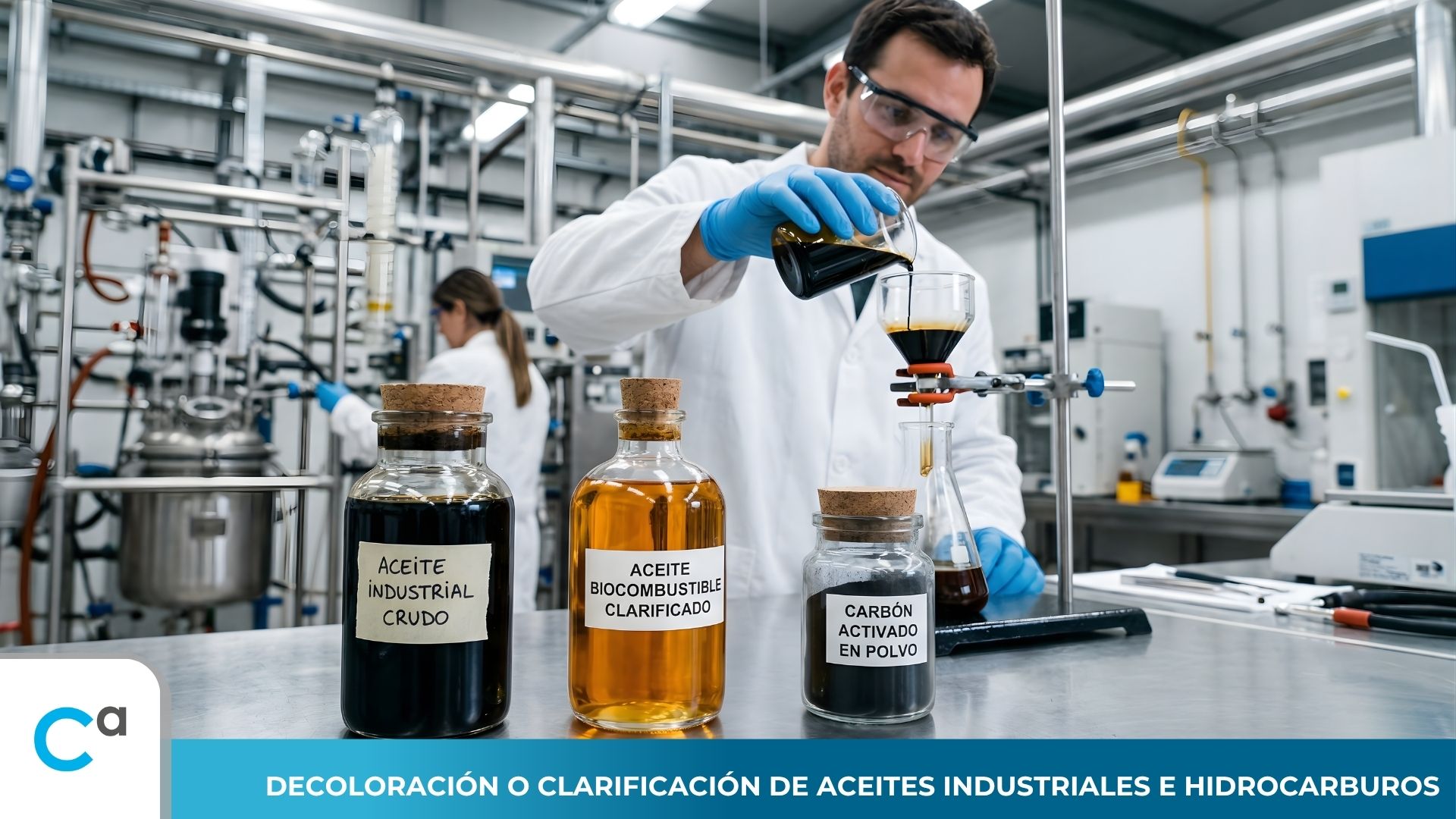
Decolorization or clarification of industrial oils, biofuels, fuels and other hydrocarbons with activated carbon
Technical guide for engineers and specialists in oil purification processes : Carbotecnia
The color of an oil is a quality parameter. In the oleochemical, biofuel and lubricant industries, visual appearance is often the buyer’s first filter and, in many cases, a regulatory requirement that drives decolorization and clarification processes.
Pigments such as chlorophylls, carotenes and compounds formed by thermal degradation increase absorbance in the visible spectrum, reduce oxidative stability and require removal. In biofuels, these compounds and their by-products can affect the performance of injection systems, which reinforces the importance of proper decolorization and clarification.
For decades, activated carbon has been one of the most efficient adsorbents for the removal of these chromophore compounds. Its large surface area – which can exceed 1,100 m²/g in high specification products – and the diversity of functional groups on its surface make it capable of capturing complex organic molecules of high molecular weight (such as highly aromatic compounds), thus achieving a higher efficiency than conventional mineral adsorbents (bleaching earths, silica), due to their limited selectivity for non-polar compounds.
1 Origin of color and turbidity in oils and hydrocarbons
1.1 Vegetable oils, lubricants and biofuels
Crude oils – both vegetable and mineral – contain a wide variety of compounds, of natural origin or generated during processing, that provide color:
- Chlorophylls and pheophytins: green pigments present in canola, soybean and sunflower oils; extremely stable against conventional alkaline refining processes.
- Carotenoids (β-carotene, lycopene): responsible for the yellow and orange hues in palm oil and some frying oils.
- Lipid oxidation products: conjugated aldehydes, α,β-unsaturated ketones and polymers generated by excessive heating or prolonged storage.
- Phenolic compounds and tars: present in oils recovered by pyrolysis or in used lubricants, they confer dark and cloudy colorations.
- Trace metals (Fe, Cu, Ni): although they are not pigments per se, they catalyze oxidation reactions that intensify color and accelerate degradation.
1.2 Hydrocarbons: gasoline, diesel, condensates and waxes
In the hydrocarbon sector, the compounds responsible for color, turbidity and undesirable odor are of different nature but most of them are adsorbable or treatable with activated carbon:
- Mercaptans and organic sulfides: confer characteristic odor and coloration to gasoline and naphtha; increase the doctor index and compromise the total sulfur specification.
- Polycyclic aromatics (PAH): present in heavy gas oils, diesel and cutting oils; responsible for dark color and classified as compounds of regulatory concern (IARC Group 2A/2B or Group 1).
- Oxidation resins and rubber precursors: low molecular weight polymers formed by the oxidation of dienes and olefins; they generate turbidity, deposits in filters and injectors.
- Basic nitrogenates (pyrroles, pyridines): act as color precursors through oxidation and polymerization color precursors through oxidation and polymerization mechanisms, degrade the color and thermal stability of medium cuts.
- Chromogenic impurities in waxes: aromatic hydrocarbons remaining in solid kerosenes that reduce the Saybolt whiteness index.
2 Mechanisms of adsorption of activated carbon on colored compounds
Color removal by powdered activated carbon mainly involves two mechanisms:
Physical adsorption (physisorption): chromophore molecules are retained in the micropores and mesopores of carbon by Van der Waals forces. This mechanism predominates for low molecular weight molecules such as aldehydes and oxidized ketones.
π-π interaction and hydrogen bonds: aromatic compounds such as chlorophylls and carotenes – which have conjugated double bond systems – establish electronic interactions with the graphitic surface of activated carbon, which explains the high affinity of this adsorbent for pigments that are difficult to remove with acid bleaching earth.
A key parameter is the pore size distribution: mesopores (2-50 nm) are determinant for the adsorption of large molecules such as chlorophyll (PM ≈ 893 g/mol), while micropores (< 2 nm) capture smaller compounds such as oxidized fatty acids and aldehydes.
3 Application cases by industry
The following table summarizes the most frequent applications, the dominant chromogenic contaminants and the type of activated carbon recommended according to the oil profile:
Industry |
Typical contaminants |
Recommended type of activated carbon |
|---|---|---|
Biodiesel (FAME) |
Chlorophyll, carotenes, phospholipids |
Powder (CAP), high surface area |
Refined palm oil |
Carotenoid pigments, trace metals |
CAP activated with phosphoric acid, high macroporosity |
Mineral oil / lubricant |
Oxidation products, dark color |
Granular (CAG) or powder (CAP) |
Sunflower/soybean oil |
Chlorophylls, thermal degradation products |
Neutral wood CAP, pH controlled |
Pyrolysis fuels |
Tars, phenolic compounds |
High mechanical strength GAC |
Technical note: in oils with high content of suspended solids or waxes, a pre-filtration stage is recommended before contact with the activated carbon, to avoid premature blockage of the porous structure and to extend the adsorbent’s useful life.
4 Technical dosing parameters for hydrocarbon clarification
The optimum activated carbon dosage depends on the initial color load (measured in APHA, Lovibond or absorbance units at 450-670 nm), the process temperature and the available contact time. The following ranges apply for batch operations with mechanical agitation:
Application |
Typical dosage (carbon) |
Temperature |
Contact time |
Biodiesel (decolorization) |
0.5 – 2.0% w/w |
60 – 80 °C |
15 – 45 min |
Refined vegetable oils |
0.1 – 1.5% w/w |
70 – 110 °C |
20 – 30 min |
Mineral oils / lubricants |
1.0 – 3.0% w/w |
Amb. – 60 °C |
30 – 60 min |
Pyrolysis fuels |
2.0 – 7.0% w/w |
40 – 70 °C |
30 – 90 min |
Gasoline / naphtha (clarification) |
0.05 – 1.0% w/w |
Amb. – 40 °C |
10 – 30 min |
Diesel / gasoil (clarification) |
0.5 – 1.5% w/w |
40 – 60 °C |
20 – 45 min |
Natural gas condensates |
0.2 – 0.8% w/w |
Amb. – 30 °C |
10 – 20 min |
Kerosene waxes |
0.5 – 2.0% w/w |
80 – 110 °C (molten) |
20 – 60 min |
Additional critical variables:
- Oil pH: in refined vegetable oils, a slightly acid pH (4.5-6.0) favors the protonation of carboxylic groups and improves the adsorption of polar compounds.
- Viscosity: high viscosity oils require higher temperature or longer contact times to ensure diffusion of the molecules into the internal pores of the carbon.
- Type of carbon (powdered vs granular): powdered activated carbon (PAC) offers greater contact area and is preferable in batch processes; granular (GAC) is suitable for continuous flow columns with in situ regeneration.
- Charcoal moisture: in non-aqueous oils, the presence of moisture in the charcoal (> 5%) can generate emulsions; it is recommended to use dry charcoal or charcoal with controlled moisture.
5 Criteria for selection of powdered activated carbon for oil decolorization
Not all activated carbons are equivalent for this service. The most relevant specification parameters are:
- Iodine number ≥ 900 mg/g: indicator of total microporosity; higher values favor the capture of low molecular weight compounds.
- Methylene blue number ≥ 200 mg/g: reflects adsorption capacity in mesopores; critical for removal of chlorophylls and carotenes of larger molecular size.
- BET area > 1,000 m²/g: reference parameter for global adsorption capacity.
- Low ash and metal content: avoids contamination of the treated oil, especially relevant in food and high purity biofuel applications.
- Controlled particle size distribution (for CAP): particles of 200-325 mesh facilitate subsequent filtration and reduce product losses.
6 Decolorization of biodiesel with powdered activated carbon
Biodiesel (fatty acid methyl ester, FAME) is one of the fluids where powdered activated carbon has the strongest and most documented application within the fuel industry. Unlike hydrocarbons of fossil origin, biodiesel comes from vegetable oils or animal fats and carries with it chromogenic compounds of an organic nature that persist even after transesterification and conventional washing.
6.1 Why does biodiesel have color?
The color of the finished biodiesel can vary from pale yellow to dark brown depending on the feedstock and process conditions. The compounds responsible are:
- Residual chlorophylls and pheophytins: from crude vegetable oil, they are extremely stable and are not completely eliminated in the transesterification stage.
- Carotenes and xanthophylls: liposoluble pigments of high persistence, especially relevant in palm or canola biodiesel.
- Thermal degradation and partial glycolysis products: colored monoglycerides and diglycerides generated by incomplete reaction.
- Traces of soaps and phospholipids: if the raw material was not properly degummed, these compounds contribute turbidity and slight coloration.
- Oxidation products of unsaturated fatty acids: biodiesel with high linolenic acid content (soybean, flax) is particularly susceptible; oxidation generates secondary chromophore compounds that darken the product even during storage.
6.2 Application of PAC in biodiesel purification
Powdered activated carbon is typically applied as a polishing step after water washing and dehydration of the biodiesel. The process is simple and compatible with batch production facilities of any scale:
- Addition of PAC directly to the dry biodiesel tank (moisture <500 ppm), with moderate mechanical agitation.
- Contact time: 20 to 45 minutes at a temperature of 60-80 °C to reduce viscosity and improve pigment diffusion into the charcoal pores.
- Typical dosage: 0.5 to 2.0% by weight with respect to the volume of biodiesel, adjustable according to the initial color load measured on the Lovibond scale or in absorbance units at 450 nm.
- Subsequent filtration: by means of a filter press or plate filter with filter aid (diatomaceous earth or perlite), to completely retain the PAC and avoid its entrainment into the final product.
It is important to note that PAC acts simultaneously on color and on minority compounds that affect the oxidative stability of biodiesel (secondary peroxides, conjugated aldehydes), which can improve the oxidation stability index (Rancimat, EN 14112) as a positive side effect of the treatment.
Practical consideration: in biodiesel produced from palm oil, carotenes represent the dominant chromogenic fraction and may require doses at the higher end of the range (1.5-2.0% w/w). In soybean or sunflower biodiesel, chlorophylls are the main contaminant and respond best to carbons with high mesoporosity (methylene blue number ≥ 220 mg/g).
7 Discoloration or clarification of hydrocarbons with activated carbon
The decolorization of hydrocarbons with activated carbon is an existing application in the industry, although less widespread than for vegetable oils or biofuels. It is important to be precise: it is not a standard process for all hydrocarbon streams, but a tool that is technically feasible and economically justified in specific scenarios where color is a sales or regulatory compliance parameter.
7.1 On which hydrocarbons does it make sense to decolorize or clarify with activated carbon?
Activated carbon – mainly in its granular form (GAC) for continuous columns, and in powder form (PAC) for smaller scale batch processes – has been documented for the following streams:
- Primary distillate gasolines and naphthas: the presence of colored indanes, naphthalenes and phenanthrenes can compromise the visual color specification in markets where the product is sold undyed. Activated carbon selectively adsorbs these polycyclic aromatics without significantly affecting the octane number or majority hydrocarbons.
- Process or finished product diesel: out-of-specification diesel streams by color (ASTM D1500 or Saybolt number) can be treated with column GAC or batch PAC as a correction step before shipment, avoiding costly reprocessing by hydrotreating.
- Kerosene waxes: In the wax industry, the Saybolt whiteness index is a critical commercial parameter. The aromatics remaining after dewaxing are responsible for the yellow or brown color; high surface area PAC (coir or charcoal) allows the molten wax to be efficiently clarified in batch processes.
- Process oils and heat transfer fluids: white mineral oils or process fluids that have darkened due to thermal oxidation or contamination can recover part of their visual specification by treatment with GAC or CAP, depending on the volume and the customer’s requirement.
- Natural gas condensates: condensate streams with colored mercaptans or traces of heavy aromatics can benefit from a bed of extruded high-hardness GAC as a polishing step prior to storage or export.
7.2 Operational differences with respect to vegetable oils
Although the adsorption principle is the same, the decolorization of hydrocarbons has important operational peculiarities that the process engineer must consider:
- Lower polarity of the medium: hydrocarbons are low polarity media, which favors competition between solvent molecules and solutes for the active sites of the carbon. In general, the effective adsorption capacity per unit of carbon is somewhat lower than in aqueous media or polar oils.
- Ignition risk: unlike vegetable oils, light hydrocarbons (gasolines, naphthas, condensates) are flammable. The process must be carried out in an inert atmosphere or with equipment designed for ATEX zones, and the operating temperature must be kept well below the flash point of the fluid.
- Preference for continuous column GAC: for continuous hydrocarbon streams (diesel, gasoline in refinery), fixed bed GAC is more suitable than batch PAC, as it allows operation without interruptions and facilitates breakthrough curve monitoring. Batch PAC is more common in smaller scale operations or in punctual corrections out of specification.
- Filtration after batch PAC: When using PAC in a batch process with hydrocarbons, post-filtration is especially critical. The final product must not contain traces of powdered carbon, as these can damage injectors, pumps or downstream process equipment. Two-stage filtration (coarse filter + 1-5 μm fine filter) is recommended.
Scope Note: For large volume refinery streams (thousands of barrels/day), activated carbon does not compete with catalytic hydrotreatment, which is the industry standard process for decolorization and sulfur reduction at scale. Activated carbon is more competitive in lower throughput streams, in batch operations, in biodiesel or second generation biofuels plants, and in finished product remediation scenarios where hydrotreating is not economically viable.
8 Operational considerations and disposal of spent coal
After the adsorption process, the saturated carbon retains the captured pigments and contaminants, so it must be handled carefully. In many countries, spent coal from industrial oils is classified as special waste and requires controlled disposal or energy recovery (co-combustion in cement kilns or cogeneration plants).
Thermal regeneration: Although activated carbon is technically a material that can be reactivated by thermal treatment (800-900 °C in a controlled atmosphere), this option is not viable when using powdered carbon (PAC). The fine particulate nature of PAC makes its handling for reintroduction into reactivation furnaces practically unfeasible: the material flies off, disperses and generates unacceptable product losses as well as operational risks. For this reason, in applications with PAC, spent coal is treated exclusively as waste for final disposal or energy recovery.
Carbotecnia: technical expertise at the service of oil purification
Carbotecnia has a specialized line of powdered and granular activated carbons, selected and evaluated for applications in industrial oils and biofuels. Our technical team can assist in the selection of the most suitable carbon, the design of the dosing protocol and the interpretation of adsorption isotherms prior to industrial scale-up.
Sources:
- Carbotecnia – Bleaching with activated carbon
carbotecnia.info/en/learning-center/activated-carbon-applications/decolorization-with-activated-carbon/ - Pohndorf et al. (2016) – Journal of Food Engineering.
doi.org/10.1016/j.jfoodeng.2016.03.028 - Decolorization of sunflower oil with activated charcoal (2018) – Int. Journal of Industrial Chemistry
link.springer.com/article/10.1007/s40090-018-0156-1 - Lee et al. (2022) – NREL: Decolorization of Biofuels and Biofuel Blends
docs.nrel.gov/docs/fy22osti/83138.pdf - Li et al. (2021) – Adsorption and decolorization of hydrogenated coal tar – ScienceDirect.
sciencedirect.com/science/article/abs/pii/S1872580521600562
Contact us to receive a personalized technical recommendation or to request evaluation samples.