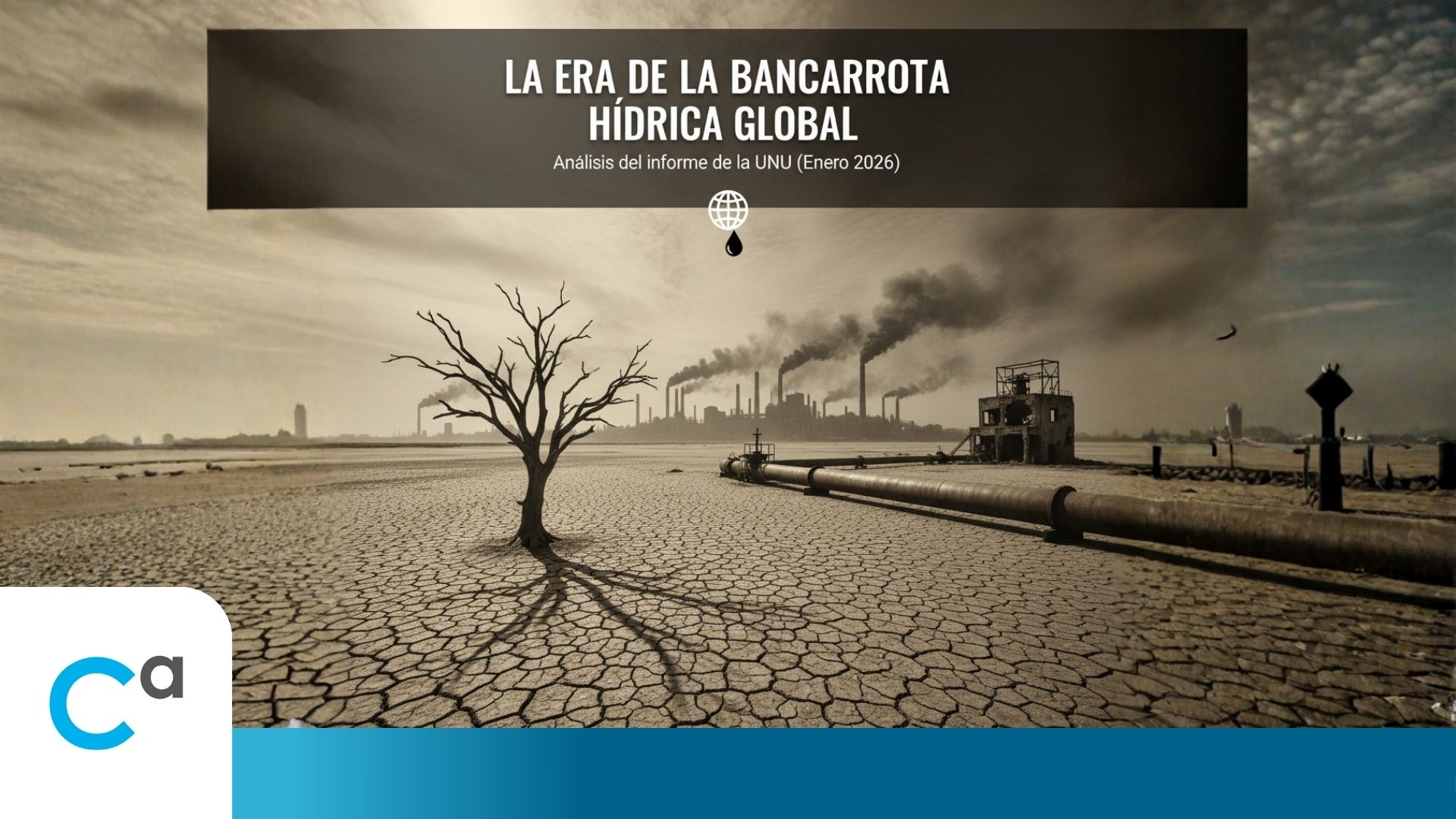
The Era of Global Water Bankruptcy
On January 20, 2026, the United Nations presented a report that redefines the narrative of global water resource management. The document warns that humanity has transcended the concept of “water stress” to formally enter the era of Global Water Bankruptcy.
Definition and context of water depletion
In the financial sphere, bankruptcy is declared when an entity exhausts its reserves and lacks the capacity to generate cash flows to cover its obligations. Similarly, the UN uses this term to describe a situation in which societies not only consume more water than the natural cycle can renew, but have liquidated the natural capital accumulated over millennia in aquifers, glaciers and wetlands.
This condition represents a turning point: the shortage is no longer a temporary crisis, but a structural insolvency that requires systemic changes in industrial and governmental operations.
Determining factors of the current crisis
The transition to water bankruptcy is the result of the convergence of four critical variables:
-
Systemic overexploitation: Extraction of surface and groundwater resources at rates that far exceed the natural recharge capacity.
-
Quality degradation: The increase in contamination levels drastically limits the possibilities of immediate use and reuse.
-
Loss of natural infrastructure: Disappearance of glaciers and degradation of regulating ecosystems due to climate change.
-
Reactive management: Public policies oriented to emergency attention instead of long-term sustainability and efficiency.
Implications for the industrial sector and urban resilience.
From a commercial and strategic perspective, the UN report should be interpreted as a warning about business continuity. Water can no longer be considered a low-cost, infinite input; it is now a high-risk strategic asset.
The viability of companies and urban development will depend on two fundamental pillars:
-
Decentralization of treatment: The transition to systems that allow on-site water recycling and treatment, reducing reliance on increasingly stressed public networks.
-
Adoption of advanced purification technologies: Solutions such as the ones we promote at Carbotecnia are no longer social responsibility initiatives, but rather an operational insurance policy necessary to mitigate the risk of interruption due to lack of supply.
Strategic perspective
The water crisis in 2026 forces us to abandon the expectation of passive climate recovery. The solution does not lie in waiting for favorable weather conditions, but in the technological optimization of each available cubic meter.
Facing water bankruptcy requires a coordinated response between technological innovation, private investment and transformative public policies. The ability of organizations to adapt will define their competitive position in this new global reality.